Showing posts with label Forest. Show all posts
Saturday, August 13, 2011
Elephant Kills a Farmer in Aceh
Many forest area in the Province of Aceh, Sumatera, has been converted into commercial plantation and other use for many decades.
This continuous deforestation process has narrowed the area of forest as habitat of endangered Sumatera Elephant, making it possible for them to have direct contacts with human beings.
AFP reported that three people have been killed by an Elephant in the province in the last three months, the latest being a rubber tapper named Abdul Halim who was attacked while he was working last Thursday.
I hope this tragic incident would make the officials at the Ministry of Forestry stop giving permits for diversion of forest so that the Sumatera Elephants, which according the WWF now totals 3,500, can remain inside their habitat and would not go out and attack human beings.
Monday, July 18, 2011
Muslim Preachers to Help Fight Deforestration
The Indonesian government has been trying hard to fight forest destruction for many years with little success.
Due to this fact, the government plan to recruit 5,000 Muslim Preachers (Juru Dakwah) to help the campaign to preserve our forrest.
According to The Jakarta Post, during a meeting of Indonesia's second largest Muslim organization i.e Muhammadiyah in Yogyakarta last Sunday, Forestry Ministry Zulkifly Hasan has called Muslim scholars to support the campaign against forest burning and to promote forest preservation and reforestation efforts.
The Muslim Preachers will be recruited from a number of Muslim organizations. They will be given relevant trainings and will be paid about Rp 2 million (US$234) per month. And the program will start later this year until 2012.
This is a very good idea. I hope that it would be successful.
Due to this fact, the government plan to recruit 5,000 Muslim Preachers (Juru Dakwah) to help the campaign to preserve our forrest.
According to The Jakarta Post, during a meeting of Indonesia's second largest Muslim organization i.e Muhammadiyah in Yogyakarta last Sunday, Forestry Ministry Zulkifly Hasan has called Muslim scholars to support the campaign against forest burning and to promote forest preservation and reforestation efforts.
The Muslim Preachers will be recruited from a number of Muslim organizations. They will be given relevant trainings and will be paid about Rp 2 million (US$234) per month. And the program will start later this year until 2012.
This is a very good idea. I hope that it would be successful.
Thursday, June 9, 2011
The Barbie Doll Helped the destruction of Indonesian Forest
Environment organization Greenpeace announced on Wednesday that the famous Barbie doll has helped the destruction of rain forests in Indonesia as habitat of endangered species like the Sumatera Tigers.
Greenpeace said that the material used in Barbie doll boxes contained timber produced by the Asia Pulp and Paper (APP), a subsidiary of palm oil and paper giant Sinar Mas group, which it described as a notorious destroyer of Indonesian natural forests especially in the Province of Riau where APP's production facility is located.
It also urged the producer of Barbie doll, Mattel, to stop wrapping the world’s most famous toy in rain forest destruction. APP denied the allegations that its activities posed any threat to the rain forests and endangered species in Indonesia.
I hope that the above Greenpeace announcement would make Sinar Mas extra careful in cutting the forest trees, and force them to make better efforts to save the forests in Indonesia
Greenpeace said that the material used in Barbie doll boxes contained timber produced by the Asia Pulp and Paper (APP), a subsidiary of palm oil and paper giant Sinar Mas group, which it described as a notorious destroyer of Indonesian natural forests especially in the Province of Riau where APP's production facility is located.
It also urged the producer of Barbie doll, Mattel, to stop wrapping the world’s most famous toy in rain forest destruction. APP denied the allegations that its activities posed any threat to the rain forests and endangered species in Indonesia.
I hope that the above Greenpeace announcement would make Sinar Mas extra careful in cutting the forest trees, and force them to make better efforts to save the forests in Indonesia
Monday, May 23, 2011
The Two Years Forest Moratorium
President SBY last Thursday signed a Presidential decree No. 10/2011, authorizing a two year moratorium on new logging concession, under a billion dollar concession with Norway.
This decree is an implementation of an agreement signed by Indonesia and Norway on May last year, in which Indonesia promised to carry out a moratorium (halt) on the cutting of forest and peatlands for two years in exchange for $1 billion in funding from Norway, under a UN-backed scheme designed to pay developing countries to preserve forests.
However, this moratorium is only for new forest licenses, and will exempt permits already given in principle by the Forestry Ministry and extensions of existing permits, as well as projects to develop supplies of energy, rice and sugar.
This decree was welcomed by the Norwegian government who said that the moratorium is one important step forward for Indonesia
But it was protested by the Indonesian Palm Oil Association (Gapki) who felt that the decree would restrict business activities.
While green activists said the moratorium would only be applicable to 64 million hectares of the country’s 132 million hectare forest coverage.
In spite of the pro and contra, I hope that the Indonesian government would carry out the moratorium i.e stop cutting forests and peatlands in the next two year as it promised
This decree is an implementation of an agreement signed by Indonesia and Norway on May last year, in which Indonesia promised to carry out a moratorium (halt) on the cutting of forest and peatlands for two years in exchange for $1 billion in funding from Norway, under a UN-backed scheme designed to pay developing countries to preserve forests.
However, this moratorium is only for new forest licenses, and will exempt permits already given in principle by the Forestry Ministry and extensions of existing permits, as well as projects to develop supplies of energy, rice and sugar.
This decree was welcomed by the Norwegian government who said that the moratorium is one important step forward for Indonesia
But it was protested by the Indonesian Palm Oil Association (Gapki) who felt that the decree would restrict business activities.
While green activists said the moratorium would only be applicable to 64 million hectares of the country’s 132 million hectare forest coverage.
In spite of the pro and contra, I hope that the Indonesian government would carry out the moratorium i.e stop cutting forests and peatlands in the next two year as it promised
Thursday, May 5, 2011
The Promise to End Illegal Logging
Last Wednesday, the Indonesian government and the European Union concluded the Voluntary Partnership Agreement on Forest Law Enforcement Governance and Trade (VPA FLEGT).that would redule Illegal Logging, Log Laundering and other related activities in Indonesia.
According to the Indonesian Ministry of Foreign Affairs this agreement will support Indonesia's efforts to strengthen Good Governance, Law Enforcement and Accountability in its Forest sector.
Indonesia plan to audit all of its 4,500 producers, processors and exporters to ensure the legality of all Timber, Paper, and Pulp products exported to the E.U and other markets.
And the E.U will guarantee free and unrestricted access for all FLEGT licensed Timber products coming from Indonesia and will seek to increase the visibility of FLEGT products in the E.U.
Indonesia and the E.U aimed to commence FLEGT licensing procedures at the beginning of 2013, ahead of the entry into operations of the E.U Timber Regulation in March 2013 which will prohibit the first sale of illegal Timer in the E.U.
I hope that this agreement will end, or at least reduce illegal logging that has plagued Indonesia for many years.
According to the Indonesian Ministry of Foreign Affairs this agreement will support Indonesia's efforts to strengthen Good Governance, Law Enforcement and Accountability in its Forest sector.
Indonesia plan to audit all of its 4,500 producers, processors and exporters to ensure the legality of all Timber, Paper, and Pulp products exported to the E.U and other markets.
And the E.U will guarantee free and unrestricted access for all FLEGT licensed Timber products coming from Indonesia and will seek to increase the visibility of FLEGT products in the E.U.
Indonesia and the E.U aimed to commence FLEGT licensing procedures at the beginning of 2013, ahead of the entry into operations of the E.U Timber Regulation in March 2013 which will prohibit the first sale of illegal Timer in the E.U.
I hope that this agreement will end, or at least reduce illegal logging that has plagued Indonesia for many years.
Labels:
European Union,
Forest,
Illegal logging,
Indonesia
Thursday, April 28, 2011
The Promise to Reduce 26% CO2 by 2020
During the summit meeting of the leaders of the world's G20 countries in 2009, President SBY promised that Indonesia shall voluntarily reduce 26% Carbon Emission by the year 2020.
He went on to say that Indonesia can even reduce Carbon Emission up to 41% if it is assisted by other countries.
In this connection, on 26 May 2010, Indonesia and Norway concluded an agreement in which Indonesia promised to stop cutting forest trees (forest moratorium) for two years and Norway will invest a total of US$ 1 Billion in forest conservation projects in Indonesia.
But promise is promise, until this now President SBY has still not yet issued a Presidential Decree regarding the 2 years forest moratorium.
Kompas quoted a government official as saying that Indonesia does not need to prioritize the target of reducing carbon dioxide by 26 percent in 2020 as Indonesia does not belong to a group of countries required to reduce their Carbon Emissions.
Considering that President SBY has already made promises to foreign countries that Indonesia shall reduce Carbon Emission, I hope that the government would be very serious in keeping the said promises.
He went on to say that Indonesia can even reduce Carbon Emission up to 41% if it is assisted by other countries.
In this connection, on 26 May 2010, Indonesia and Norway concluded an agreement in which Indonesia promised to stop cutting forest trees (forest moratorium) for two years and Norway will invest a total of US$ 1 Billion in forest conservation projects in Indonesia.
But promise is promise, until this now President SBY has still not yet issued a Presidential Decree regarding the 2 years forest moratorium.
Kompas quoted a government official as saying that Indonesia does not need to prioritize the target of reducing carbon dioxide by 26 percent in 2020 as Indonesia does not belong to a group of countries required to reduce their Carbon Emissions.
Considering that President SBY has already made promises to foreign countries that Indonesia shall reduce Carbon Emission, I hope that the government would be very serious in keeping the said promises.
Tuesday, March 22, 2011
Aceh's Logging Moratorium Nominated for International Award
When the Flash Flood hit Pidie in the province of Aceh, on 28 February, the Governor of Aceh stated that the tragedy was caused by illegal logging i.e. cutting of forest trees, in said province.
This statement surprised me because the provincial government of Aceh has issued a Logging Moratorium i.e. stop the cutting of forest trees, since 2007.
But today I was happy when I read on The Jakarta Globe that the World Future Council has nominated the Instruction of the Governor of Nanggroe Aceh Darussalam No.5/INSTR/2007 re: Logging Moratorium as one of the nominees for the World's Best Forrest Policies.
Beside Aceh's Logging Moratorium, Forrest policies from Bhutan, Brazil, Costa Rica, Ecuador, Finland, Gambia, Guatemala, Kenya, Nepal, Norway, India, Rwanda, Turkey, the United States of America and Vietnam had also been short-listed.
Three winning policies will be announced on 21 September at the United Nations headquarters in New York.
Considering the above I felt that in spite of the obstructions in the implementation of the Logging Moratorium that caused illegal logging still exist, efforts to preserve forrest in Aceh are still considered successful.
I hope that this nomination will strengthen the will and spirit of the provincial government and law enforcement agencies in the province of Aceh to eliminate illegal logging and bring those responsible to the Court of Law.
This statement surprised me because the provincial government of Aceh has issued a Logging Moratorium i.e. stop the cutting of forest trees, since 2007.
But today I was happy when I read on The Jakarta Globe that the World Future Council has nominated the Instruction of the Governor of Nanggroe Aceh Darussalam No.5/INSTR/2007 re: Logging Moratorium as one of the nominees for the World's Best Forrest Policies.
Beside Aceh's Logging Moratorium, Forrest policies from Bhutan, Brazil, Costa Rica, Ecuador, Finland, Gambia, Guatemala, Kenya, Nepal, Norway, India, Rwanda, Turkey, the United States of America and Vietnam had also been short-listed.
Three winning policies will be announced on 21 September at the United Nations headquarters in New York.
Considering the above I felt that in spite of the obstructions in the implementation of the Logging Moratorium that caused illegal logging still exist, efforts to preserve forrest in Aceh are still considered successful.
I hope that this nomination will strengthen the will and spirit of the provincial government and law enforcement agencies in the province of Aceh to eliminate illegal logging and bring those responsible to the Court of Law.
Labels:
Aceh,
Floods,
Forest,
Illegal logging,
moratorium
Saturday, February 19, 2011
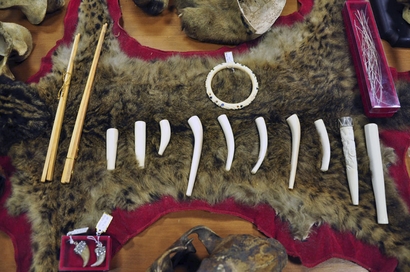
Online Trading of Wildlife Parts
Nowadays people can buy and sell all kinds of goods through online websites such as Amazon.
Unfortunately not all of the traded goods are legal, some are illegal, for example parts of endangered wildlife.
According to the Canadian Press, the Police and Forestry officials have arrested a man in his art shop in North Jakarta on 9 February for allegedly using the internet to sell hundreds of illegal wildlife parts, including Ivory, Tiger skin and teeth of the world's smallest bear.
Monster and Critics quoted a Forestry official as saying that the man may possibly be part of an international illegal wildlife trafficking ring, and if found guilty he could face a maximum of 10 years prison sentence.
I hope that the authorities would do their best efforts to prevent the sales-purchase of illegal wildlife parts among others by making sure that this man would be prosecuted, tried and punished so that other would not follow his illegal actions.
Photo : Courtesy of ExpertNews.
Wednesday, February 16, 2011
How is the Forest Moratorium ?
On 26 May 2010, Indonesian President Susilo Bambang Yudoyono (SBY) and Norwegian Prime Minister Jens Stoltenberg withnessed an agreement in Oslo under which Norway will invest in US$ 1 Billion forest conservation projects in Indonesia.
In return, Indonesia will suspend for two years new concessions for the conversion of peat and natural forests lands.
Part of the money will be spent on creating monitoring systems and pilot projects under as U.N backed forest preservation scheme called Reduced Emissions from Deforestation and Degradation (REDD) which allows developing countries to earn money by not cutting down trees and preserving Carbon-rich peat lands, seen as a key to slow climate change because forest soak up huge amounts of greenhouse gases.
To implement the deal, Indonesia must set up a new government agency that will prioritize and coordinate REDD projects.
On 30 December 2010, President SBY announced that the Province of Central Kalimantan has been selected as a pilot REDD province, however he has not sign a decree that will make the forest moratorium legally binding.
But until February 2011, President SBY has still not sign a presidential decree that would serve as a legal instrument to stop the conversion of forest land into commercial plantations and mining area.
In return, Indonesia will suspend for two years new concessions for the conversion of peat and natural forests lands.
Part of the money will be spent on creating monitoring systems and pilot projects under as U.N backed forest preservation scheme called Reduced Emissions from Deforestation and Degradation (REDD) which allows developing countries to earn money by not cutting down trees and preserving Carbon-rich peat lands, seen as a key to slow climate change because forest soak up huge amounts of greenhouse gases.
To implement the deal, Indonesia must set up a new government agency that will prioritize and coordinate REDD projects.
On 30 December 2010, President SBY announced that the Province of Central Kalimantan has been selected as a pilot REDD province, however he has not sign a decree that will make the forest moratorium legally binding.
But until February 2011, President SBY has still not sign a presidential decree that would serve as a legal instrument to stop the conversion of forest land into commercial plantations and mining area.
Labels:
Carbon Gas Emission,
Forest,
Norway,
President SBY
Tuesday, January 18, 2011
Uncertain Forest Moratorium
On 26 May 2010, the Indonesian government signed a Letter of Intent (LoI) with the Norwegian government in Oslo, whereby Indonesia promised to reduce emission from deforestation and degradation (REDD), and Norway will pay a compensation of US$ One Billion in return.
For this purpose, the Indonesian government shall impose a Forestry Moratorium i.e. stop deforestration for a two years period starting 1 Januari 2011.
But unfortunately, until today, 18 January, the government still has not made any decision to stop deforestation in Indonesia.
I wonder whether the government delayed the moratorium because of the strong protests made by forests based businessmen and politicians who said that the compensation offered by Norway is too small compared to tax money that the government would collect from palm plantation and forestry industries.
I really hope that the government would stick to the commitment stated in the LoI, not just because of the US$ One Billion compensation but most of all because it will save our forest from destruction at least for the next two years.
Sources :
- Menhut tegaskan LoI Indonesia-Norwegia Lindungi Hutan (HukumOnline)
- LoI Moratorium Hutan Jangan Ditanggapi (Kompas)
- Kompensasi Moratorium Hutan Indonesia Dinilai Terlalu Kecil (WWF)
For this purpose, the Indonesian government shall impose a Forestry Moratorium i.e. stop deforestration for a two years period starting 1 Januari 2011.
But unfortunately, until today, 18 January, the government still has not made any decision to stop deforestation in Indonesia.
I wonder whether the government delayed the moratorium because of the strong protests made by forests based businessmen and politicians who said that the compensation offered by Norway is too small compared to tax money that the government would collect from palm plantation and forestry industries.
I really hope that the government would stick to the commitment stated in the LoI, not just because of the US$ One Billion compensation but most of all because it will save our forest from destruction at least for the next two years.
Sources :
- Menhut tegaskan LoI Indonesia-Norwegia Lindungi Hutan (HukumOnline)
- LoI Moratorium Hutan Jangan Ditanggapi (Kompas)
- Kompensasi Moratorium Hutan Indonesia Dinilai Terlalu Kecil (WWF)
Wednesday, December 22, 2010
Orang Utan Rescue
Every year, around 2,000 to 3,000 Orang Utan died because of loss of habitat i.e. forests in the Island of Kalimantan a.k.a Borneo, that are tranformed into commercial plantations.
Today there are only around 45,000 to 55,000 Orang Utan left, most of them in Indonesian provinces on the Southern part of the Island, and 15,000 in Malaysian States on the Northern part of the Island.
Efforts have been made to rescue the Orang Utan from extinction, details of which can be found on the article I quoted from The Star (below).
By Amy Chew
The orang utan is our closest ‘relative’ yet we have taken more than our fair share of the land, destroying their habitat, driving them to certain death. Two foundations are racing against time to lease forest land to shelter them. They need our help.
THIS cuddly, adorable baby orang-utan is an orphan in Indonesia’s Central Kalimantan. Thousands of them are also found in Sumatra island and Malaysia’s state of Sabah and Sarawak.
Under what circumstances his mother died, his carers at the Nyaru Menteng Orang Utan Rehabilitation Centre do not know.
Helpless: This baby orang utan is an orphan in
But what is certain she met with a cruel and violent end – hacked to pieces, burnt or shot to death – like so many others before her.
As forest land is cleared by legal and illegal logging, palm oil and other agricultural plantations, thousands of orang utans are losing their habitat and source of food.
Hungry and desperate for food, they sometimes wander into palm oil plantations and eat the shoots of young plants where plantation workers will kill them in the most inhumane way.
“Palm oil workers, often offered a bounty, will take out these orang utan by any means possible,” says Michelle Desilets, founder of the Orang Utan Land Trust (OLT).
“Our rescue teams have found orang utan beaten unconcious and buried alive, butchered with machetes, beaten to death with iron bars and wooden planks,” she says.
“There have been times when the workers douse the orang utan with petrol and then throw a lighted match, burning them alive,” Desilet adds.
Every year, an estimated 2,000-3,000 orang utan perish from the loss of their habitat, causing them to die of starvation or suffer cruel deaths.
Today there are only around 45,000 to 55,000 Orang Utan left, most of them in Indonesian provinces on the Southern part of the Island, and 15,000 in Malaysian States on the Northern part of the Island.
Efforts have been made to rescue the Orang Utan from extinction, details of which can be found on the article I quoted from The Star (below).
Sunday December 19, 2010
My mother was burnt alive
By Amy Chew
sundaymetro@thestar.com.my
The orang utan is our closest ‘relative’ yet we have taken more than our fair share of the land, destroying their habitat, driving them to certain death. Two foundations are racing against time to lease forest land to shelter them. They need our help.THIS cuddly, adorable baby orang-utan is an orphan in Indonesia’s Central Kalimantan. Thousands of them are also found in Sumatra island and Malaysia’s state of Sabah and Sarawak.
Under what circumstances his mother died, his carers at the Nyaru Menteng Orang Utan Rehabilitation Centre do not know.
Indonesia’s Central Kalimantan Nyaru Menteng
Rehabilitation Centre.
As forest land is cleared by legal and illegal logging, palm oil and other agricultural plantations, thousands of orang utans are losing their habitat and source of food.
Hungry and desperate for food, they sometimes wander into palm oil plantations and eat the shoots of young plants where plantation workers will kill them in the most inhumane way.
“Palm oil workers, often offered a bounty, will take out these orang utan by any means possible,” says Michelle Desilets, founder of the Orang Utan Land Trust (OLT).
“Our rescue teams have found orang utan beaten unconcious and buried alive, butchered with machetes, beaten to death with iron bars and wooden planks,” she says.
“There have been times when the workers douse the orang utan with petrol and then throw a lighted match, burning them alive,” Desilet adds.
Every year, an estimated 2,000-3,000 orang utan perish from the loss of their habitat, causing them to die of starvation or suffer cruel deaths.
Safe: A baby Orang Utan from the Sepilok Rehabilitation Centre.
Orang utan also die when forests fires break out, either set alight by the dry season, or deliberate burning by errant plantations or traditional farmers.
The orang utan, which means people of the forest, is our closest relative. It has a DNA which is almost 98% of that of a human being.
Only two percent separate us from these highly-intelligent creatures who have the capacity to feel the same emotions as a human being – pain, joy or sorrow.
The female orang utan are amongst the most protective mammals in the animal kingdom, who will give up their lives to protect their young.
When poachers hunt for baby orang utan to be sold off at a princely sum to animal traffickers, they always have to kill the mother who will defend her young to her last breath.
It is estimated that only 45,000-55,000 orang utan are left in the wild. Of that, 11,000 are in Sabah and another 4,000 in Sarawak.
More than a century ago, some scientists estimate there could have been as many as a million of these creatures.
OLT and Borneo Orangutan Survival Foundation (BOS) are working together to secure land in Kalimantan to save the orang utans from extinction.
OLT, a registered charity in England and Wales, supports sustainable solutions for the long-term survival of the orang utan in the wild by securing safe forests for their continued existence.
“If we can secure forests BEFORE it is cleared, then fewer orang utans will face this fate ... so that orang utans do not face a lifetime in a cage in a rescue centre,” said Desilets.
BOS is an non-profit organisation with the vision to establish a Bornean orang utan conservation in its natural habitat. It’s financial reports are audited annually by reputable auditors.
BOS, with the support of OLT, is raising money to lease 300,000ha of tropical forest land spread across the vast expanse of Kalimantan to save the orang utan from certain death.
The 60-year-lease for the 300,000ha from the Indonesian government costs 45 billion rupiah (RM15.9 million).
“To date, BOS Foundation has raised 13 billion rupiah (RM4.56 million) to pay for the licence fee in East Kalimantan for an area of 86,450 hectares,” said BOS chairman Togu Manurung.
BOS still needs to raise the remaining sum of money to pay for licence fees for the remaining 213,550 hectares of land as well as to fund the costs of transporting the orang utan to leased forest land.
With 25ha of rainforest being destroyed every minute, time is running out.
Instead of another nice dress or shirt, why not give someone a meaningful Christmas gift by donating to give the orang utan a chance to live?
In doing so, we restore our own humanity, worthy to be called human.
To donate, go to www.forests4orangutans.org or www.orangutan.or.id.
Sunday, October 24, 2010
The Burning of Forest in Sumatra
Smokes originating from the burning of forest in the Island of Sumatra in the last few days has been causing heavy air pollution in Singapore and Malaysia.
Due to this fact, the governments of Singapore and Malaysia have complained and urged the Indonesian government to take immediate action to stop the fire, for which purpose they both offered their assistance.
These offers were welcomed by Indonesian Foreign Minister Marti Natalegawa who said that the smoke problem is a transnational problem that cannot be solved by Indonesia alone, but required cooperation among countries in the region.
According to Indonesian Minister of Environment Gusti Hatta, most of the fires were set by farmers practicing slash and burn agriculture in Riau Province, Sumatra. He also said that The minister's deputy told reporters that his office is sending a team to Riau to find our more details as to the cause of fire.
Considering that the smoke has caused heavy air pollution in other countries, they must have originated from heavy burning of forests by so many people that can either be farmers or workers or plantation companies.
The question is : why did the Forestry Ministry blamed only traditional farmers and not the plantations ?
For details, please read the following articles :
- Govt says haze from RI, blames traditional farmers (The Jakarta Post)
- Sumatra Smoke Clouds Sky Over Malaysia, Singapore (The Jakarta Globe)
- Return of the Haze "We can't fight alone" (Strait Times)
Photo : Courtesy of Reuter.
Wednesday, August 11, 2010
SMART vs. Greenpeace
Environment organization Greenpeace has continuously alleged that Indonesia's largest producer of Palm Oil i.e Sinar Mas Agri (SMART) has massively cleared Peatland and Primary Forests as habitat of Orangutan in Indonesia.
Due to this fact, SMART has lost major customers of its products including Unilever, Nestle and Kraft.
So in order to counter the allegations, SMART has commissioned two independent inspection companies i.e. Control Union Certifications and BSI, to carry put an audit on this matter.
And last Tuesday, SMART president Daud Dharsono told reporters that the result of audit shows that the above allegations were largely unfounded and that SMART was not responsible for deforestation of primary forests and the destruction of Orangutan habitats.
However, Greenpeace denied this saying that said audit has actually "confirmed Greenpeace's findings" that the company cleared Peatland and Primary Forests.
Source : AFP/Google
Due to this fact, SMART has lost major customers of its products including Unilever, Nestle and Kraft.
So in order to counter the allegations, SMART has commissioned two independent inspection companies i.e. Control Union Certifications and BSI, to carry put an audit on this matter.
And last Tuesday, SMART president Daud Dharsono told reporters that the result of audit shows that the above allegations were largely unfounded and that SMART was not responsible for deforestation of primary forests and the destruction of Orangutan habitats.
However, Greenpeace denied this saying that said audit has actually "confirmed Greenpeace's findings" that the company cleared Peatland and Primary Forests.
Source : AFP/Google
Friday, August 6, 2010
Illegal Logging Today
President Susilo Bambang Yudoyono has promised international leaders that Indonesia will voluntarily reduce 26% Carbon Emission by 2020. And if we are helped by other countries, we can even reduce up to 41%
For this purpose, the government has planned massive replantation of forest trees and to stop the cutting of forest trees.
However, it seems that it's not easy to stop the cutting of forest trees because many of them are done illegally as reported by Kompas below.
Due to this fact, I hope that the the government would do everything in its power to stop illegal cutting of forest trees, that way Indonesia can keep its promise to reduce Carbon Emission.
For this purpose, the government has planned massive replantation of forest trees and to stop the cutting of forest trees.
However, it seems that it's not easy to stop the cutting of forest trees because many of them are done illegally as reported by Kompas below.
Due to this fact, I hope that the the government would do everything in its power to stop illegal cutting of forest trees, that way Indonesia can keep its promise to reduce Carbon Emission.
Indonesia 'Woefully Inadequate' on Illegal Loggers
Kamis, 5 Agustus 2010 | 17:38 WIB
AFP
This aerial picture taken on July 6, 2010, over eight concession areas of Indonesias biggest palm oil firm Sinar Mas, shows receding forest cover near Sinar Mas plantation area in Kapuas Hulu in West Kalimantan province on Borneo island. Sinar Mas is undergoing an independent audit of its practices, the results of which are expected in July following a Greenpeace report that the Indonesian firm was devastating rainforests and driving endangered species like orangutans into extinction. Anglo-Dutch food and cosmetics giant Unilever said on May 19, 2010 it would continue to get 65 percent of its total palm oil purchases from Indonesia, despite concerns about deforestation by the industry. Nestle, the worlds largest food company, had also dropped Sinar Mas as a palm oil supplier but said on May 17, 2010 it would resume buying from the company if an independent audit cleared the Jakarta-based firm of improper practices. Borneo island is rapidly losing its vast virgin forest due to palm oil plantations and illegal logging that is largely contributing to global warming. Sinar Mas said the palm oil industry is crucial to alleviating poverty in Indonesia as it provides direct employment for about 4.5 million people and generated 10.4 billion USD worth of exports last year.
JAKARTA, KOMPAS.com - Indonesia is allowing powerful businessmen to get rich from smuggling rare timber to China despite its pledges to crack down on illegal logging and preserve its forests, environmentalists said Thursday. An undercover probe by the independent Environmental Investigation Agency (EIA) and local group Telapak found rampant smuggling of merbau, a valuable hardwood found mainly in Papua.
The probe tracked the illicit trade from the forests to the ships where the wood was being illegally exported, mainly to China, with the help of corrupt officials. Complaints to authorities about the two alleged kingpins in the trade had achieved nothing, the groups said in a report.
“While the huge quantity of illegal timber flowing from Indonesia during the first half of the decade has declined, effective law enforcement against those responsible — the financiers, company bosses and corrupt officials — has been woefully inadequate,” EIA campaign director Julian Newman said.
The groups called on Indonesian President Susilo Bambang Yudhoyono to make good on his promises to crack down on what he has called the “logging mafia” that is accused of destroying much of the country’s pristine forests. Indonesia is one of the world’s biggest emitters of greenhouse gases blamed for global warming, mainly through deforestation.
Yudhoyono has pledged to slash its emissions by more than 40 percent over 2005 levels by 2020, as long as foreign donors pour billions of dollars into the country for forest preservation.
“The illegal trade of merbau is symptomatic of the wider problems and the governance failure in the forest sector in Indonesia,” Newman told reporters.
“It is not only the problems of Indonesia. China has been wide open to illegal timbers. We hope China will follow the US and the EU in banning illegal timber in a bid to protect forests.”
Telapak representative Hapsoro said the government was allowing the kingpins of the illegal trade to run riot.
“It is time for Indonesia to redouble its efforts to combat timber smuggling by going after the main culprits,” he said.
The probe tracked the illicit trade from the forests to the ships where the wood was being illegally exported, mainly to China, with the help of corrupt officials. Complaints to authorities about the two alleged kingpins in the trade had achieved nothing, the groups said in a report.
“While the huge quantity of illegal timber flowing from Indonesia during the first half of the decade has declined, effective law enforcement against those responsible — the financiers, company bosses and corrupt officials — has been woefully inadequate,” EIA campaign director Julian Newman said.
The groups called on Indonesian President Susilo Bambang Yudhoyono to make good on his promises to crack down on what he has called the “logging mafia” that is accused of destroying much of the country’s pristine forests. Indonesia is one of the world’s biggest emitters of greenhouse gases blamed for global warming, mainly through deforestation.
Yudhoyono has pledged to slash its emissions by more than 40 percent over 2005 levels by 2020, as long as foreign donors pour billions of dollars into the country for forest preservation.
“The illegal trade of merbau is symptomatic of the wider problems and the governance failure in the forest sector in Indonesia,” Newman told reporters.
“It is not only the problems of Indonesia. China has been wide open to illegal timbers. We hope China will follow the US and the EU in banning illegal timber in a bid to protect forests.”
Telapak representative Hapsoro said the government was allowing the kingpins of the illegal trade to run riot.
“It is time for Indonesia to redouble its efforts to combat timber smuggling by going after the main culprits,” he said.
Labels:
Carbon Gas Emission,
Forest,
Illegal logging,
Indonesia
Wednesday, June 2, 2010
Cancellation of Forestry Permits
During his visit to Oslo last week, President Susilo Bambang Yudoyono reached an agreement with the Norwegian government in which the latter promised to provide Indonesia with US$ 1 Billion in grant if it stop deforestation.
In this connection, Reuter (below) reported that Indonesia shall cancel forestry permits that have been issued to Palm Oil and Timber companies, and shall not issue new permits in the next two years.
I hope that it would not be very difficult for Indonesia to keep this promise.
Indonesia to scrap permits to save forests-official
By Sunanda Creagh
JAKARTA May 31 (Reuters) - Indonesia will revoke existing forestry licences held by palm oil and timber firms to save natural forests under a $1 billion climate change deal signed with Norway last week, a government official said on Monday.
Indonesia's president, Susilo Bambang Yudhoyono, who announced the deal last week in Oslo, said new concessions for the conversion of natural forest and peatlands would be suspended for two years. But he did not say at the time how existing concessions would be affected. [ID:nJAK326556].
Preserving forests is seen as crucial to slowing climate change because trees absorb enormous amounts of greenhouse gases.
Indonesia has huge tracts of tropical forests but a rapid deforestation rate. It has pledged to cut emissions by 2020 to 26 percent lower than the level if no action were taken or 41 percent lower if it is able to secure foreign funding and other assistance, like technology.
Part of the $1 billion promised by Norway will be spent on compensating businesses that have existing concessions cancelled in order to keep forests standing, said Agus Purnomo, head of the secretariat of Indonesia's National Climate Change Council.
"When you revoke licences, when you cancel things, it involves money," Purnomo told Reuters by telephone.
"It's not that we will cancel all licences but (only) if there is a need to do so" to keep primary forest intact, he said.
Compensation to permit holders could include cash, land swaps or other "amicable, workable and realistic solutions", he said.
Palm oil firms such as Wilmar (WLIL.SI) and Indofood Agri Resources (IFAR.SI) have ambitious expansion plans in Indonesia, already the largest producer of an oil used to make products ranging from chocolate to soap.
Palm oil and pulp and paper firms are most likely to be affected, said Purnomo.
"But I am not ruling out any possibility. The spirit of the agreement was to save the remaining natural forest and peatland and we will do whatever humanly possibly to make it happen, within the legal context of Indonesia," he said.
"If we have to go through cancellations in the court system, we will do it."
Permit holders will find out within six months if their concessions will be honoured, he said.
"Some of them don't have a valid permit, they are just making a claim," said Purnomo. "If they don't have a valid permit, we are not going to compensate. If they are getting it through bribery, we are not going to give" compensation.
A text of the Oslo agreement, seen by Reuters, suggests that the moratorium on new concessions for conversion of peat and natural forests will not be implemented until 2011. The document said that the deal will be broken into two phases.
The first phase, which runs until the end of 2010, focuses mainly on preparing and implementing pilot projects under a U.N.-backed forest preservation scheme called reduced emissions from deforestation and degradation (REDD).
REDD allows developing nations to earn money by not chopping down their forests.
The second phase of the deal, running from 2011 to 2013, will focus on REDD, law enforcement and capacity building.
The commitment to a two-year suspension on all new concessions for conversion of peat and natural forests is listed in phase two, suggesting it does not come into effect until 2011. (Editing by Sara Webb and Sugita Katyal)
In this connection, Reuter (below) reported that Indonesia shall cancel forestry permits that have been issued to Palm Oil and Timber companies, and shall not issue new permits in the next two years.
I hope that it would not be very difficult for Indonesia to keep this promise.
Indonesia to scrap permits to save forests-official
By Sunanda Creagh
JAKARTA May 31 (Reuters) - Indonesia will revoke existing forestry licences held by palm oil and timber firms to save natural forests under a $1 billion climate change deal signed with Norway last week, a government official said on Monday.
Indonesia's president, Susilo Bambang Yudhoyono, who announced the deal last week in Oslo, said new concessions for the conversion of natural forest and peatlands would be suspended for two years. But he did not say at the time how existing concessions would be affected. [ID:nJAK326556].
Preserving forests is seen as crucial to slowing climate change because trees absorb enormous amounts of greenhouse gases.
Indonesia has huge tracts of tropical forests but a rapid deforestation rate. It has pledged to cut emissions by 2020 to 26 percent lower than the level if no action were taken or 41 percent lower if it is able to secure foreign funding and other assistance, like technology.
Part of the $1 billion promised by Norway will be spent on compensating businesses that have existing concessions cancelled in order to keep forests standing, said Agus Purnomo, head of the secretariat of Indonesia's National Climate Change Council.
"When you revoke licences, when you cancel things, it involves money," Purnomo told Reuters by telephone.
"It's not that we will cancel all licences but (only) if there is a need to do so" to keep primary forest intact, he said.
Compensation to permit holders could include cash, land swaps or other "amicable, workable and realistic solutions", he said.
Palm oil firms such as Wilmar (WLIL.SI) and Indofood Agri Resources (IFAR.SI) have ambitious expansion plans in Indonesia, already the largest producer of an oil used to make products ranging from chocolate to soap.
Palm oil and pulp and paper firms are most likely to be affected, said Purnomo.
"But I am not ruling out any possibility. The spirit of the agreement was to save the remaining natural forest and peatland and we will do whatever humanly possibly to make it happen, within the legal context of Indonesia," he said.
"If we have to go through cancellations in the court system, we will do it."
Permit holders will find out within six months if their concessions will be honoured, he said.
"Some of them don't have a valid permit, they are just making a claim," said Purnomo. "If they don't have a valid permit, we are not going to compensate. If they are getting it through bribery, we are not going to give" compensation.
A text of the Oslo agreement, seen by Reuters, suggests that the moratorium on new concessions for conversion of peat and natural forests will not be implemented until 2011. The document said that the deal will be broken into two phases.
The first phase, which runs until the end of 2010, focuses mainly on preparing and implementing pilot projects under a U.N.-backed forest preservation scheme called reduced emissions from deforestation and degradation (REDD).
REDD allows developing nations to earn money by not chopping down their forests.
The second phase of the deal, running from 2011 to 2013, will focus on REDD, law enforcement and capacity building.
The commitment to a two-year suspension on all new concessions for conversion of peat and natural forests is listed in phase two, suggesting it does not come into effect until 2011. (Editing by Sara Webb and Sugita Katyal)
Sunday, May 23, 2010
New Species Found in the Forests of Papua
The Indonesian province in the western part of the Island of Papua seems to have lots of unknown species.
Recently, ECPulse (below) reported that some Australian scientist have found news species in the province' forest.
I hope that the central and provincial governments would protect said forest so as to maintain the habitat of those species.
Recently, ECPulse (below) reported that some Australian scientist have found news species in the province' forest.
I hope that the central and provincial governments would protect said forest so as to maintain the habitat of those species.
Surprising new species found in the virgin forests of Foja Mountains
Nature does not stop short of surprises! The Australian scientists found hidden in the virgin forests of Foja Mountains in western Indonesia several new species, including a Pinocchio-nosed frog and the world's smallest wallaby (kangaroo).
The Australian scientist Paul Oliver is the one lead the team during an expedition to the Foja Mountains in West Papua in Indonesia that started in 2008, and which led to the incredible discovery of several new species.
Although Paul Oliver and his team endured torrential rainstorms and life-threatening floods, they were determined to explore the isolated and most undeveloped rainforest block in the Asia-Pacific region because of its precious biodiversity.
"It is not an exaggeration to say that the Foja Mountains are well-defended against any access", said expedition participant Bruce Beehler. Seemingly, their appears that their expedition was not disappointing at all.
The 300,000 hectares of undeveloped and undisturbed rainforest in the Foja Mountains were hiding several new species, including never-before-seen mammals, a reptile, an amphibian, at least 12 insects and a new bird.
The amphibian is a tree frog with a Pinocchio-like spiked nosed which points upward when the male is calling but then deflates when the frog is less active. The wallaby that was found appears to be the world’s smallest kangaroo; however, they also spotted an extremely rare golden-mantled tree-kangaroo.
Scientists also discovered an oversized woolly rat, a bent-toed gecko with intriguing yellow eyes, a new blossom bat that feeds on rainforest nectar, a small new tree-mouse, a new black and white butterfly, a new flowering shrub and a new imperial pigeon with rusty, whitish and grey colored feathers.
Scientists however warned that growing population, deforestation and climate change might lead to the loss of this biodiversity, and urged the government to conserve it and “pay more attention to protecting the new species that have not been recorded yet”.
Friday, April 16, 2010
Forest and Plantation
Environment activists have been campaigning against the transformation of forests into commercial plantations in Indonesia..
They have successfully persuaded two of the world's largest buyer of Crude Palm Oil (CPO), Unilever and Nestle, to stop buying from Indonesia's Palm plantation and producer of CPO i.e. PT Sinar Mas, because it has allegedly cut and burned trees to clear the forests therefore driving away endangered species like the Sumatera Tigers, Elephants, Rhinoceros, etc from their natural habitat...
Meanwhile, The Jakarta Post reported that the government has recently dropped its plan to regard Plantations as Forests.
I hope that the government would stop granting license to transform forest into commercial plantations so that Indonesia can reduce gas emission by 26% in 2020 as promised by President SBY.
Friday, April 16, 2010 9:33AM
Govt drops designating plantations as forests
Adianto P. Simamora , The Jakarta Post , Jakarta | Wed, 04/14/2010 8:43 AM | National
The statement was made by the ministry’s head of research and development Tachrir Fathoni on the sidelines of a seminar on Indonesian forestry following the Copenhagen climate talks.
“We have dropped it. No more talk about it,” he told reporters on Tuesday.
He said the ministry acknowledged that any changes on forest definitions should be made by amending the 1999 forest law.
The law defines forest as an integrated ecosystem in the form of land comprising biological resources, dominated by trees in natural forms and surrounding environment, and which cannot be separated from each other.
The same statement was also made by Nur Masripatin, the ministry’s director of the center for social economics and policy research.
“Indonesia will not include palm plantations as part of forest although some countries have done it,” she said on the sideline of seminar.
Malaysia, the second largest producer of palm oil after Indonesia, uses the UN Food and Agriculture Organization (FAO) standard to identify forest — which is land with tree crown cover of more than 10 percent and an area of more than 0.5 hectares with trees reaching a minimum height of five meters.
The forestry ministry planned to draft a ministerial decree to include oil palm plantations as forest after the Copenhagen meeting.
But a group of activists from Greenpeace Indonesia and the Indonesian Environmental Forum (Walhi) criticized the government over its plans accusing the authorities of not being serious on promises to cut greenhouse gas emissions.
Greenpeace Indonesia then put a giant banner at the ministry of forestry building reading “plantations are not forests”.
Greenpeace said inclusion of ‘plantations’ in the definition of forests, would lead to massive concealment of emissions from the destruction of peat land and forests.
On Tuesday, Walhi welcomed the decision from the government to drop the plan.
“The ministry’s decision to not include plantations in forest is correct, the most important thing
now is the ministry should exclude the industrial forest concessions (HTI) as part of the forest,” Walhi’s forest campaign director, Teguh Surya.
HTI usually carries monoculture plants like acacia for paper mills.
He said that the ministry should also audit the existing oil palm plantations which converted forest areas without permits.
“Forestry Minister [Zulkilfli Hasan] should gather the courage to withdraw the licenses of oil palm plantations operating in forest areas,” he said.
The Agriculture Ministry earlier said it planned to use 1.8 million hectares of land designated as industrial forests (HTI) for oil palm plantations.
Agriculture Minister Suswono said that of 9.7 million hectares of land available for oil palm plantation, some 7.9 million hectares was already developed, leaving 1.8 million hectares designated as HTI.
Thursday, April 8, 2010
Verification over Forest Destruction
In 2008, international environment organization Greenpeace announced that some producers of Crude Palm Oil(CPO), including PT. Sinar Mas, had converted natural forest and peat land as habitats for Orangutan, Tigers, Rhinoceros, into oil palm plantations.
As a result, Unilever, as the world's largest buyer of CPO, has stopped buying from PT. Sinar Mas.
Due to which fact, according to The Jakarta Post, PT. Sinar Mas has assigned two international surveyors i.e. Control Union Certification (CUC) and British Standard Institute (BSI) to clarify this matter.
I hope that the above international surveyors would clarify this matter based on the truth.
Verification over forest destruction claims to be completed in June
Publicly listed crude palm oil (CPO) producer PT Sinar Mas Agro Resources and Technology (SMART) expects to have a verification work over forest destruction claims finished by June’s end.
“We have delivered the term of reference (part of the verification work) to the two consulting (firms) … we still need to arrange some details,” SMART president Daud Dharsono told reporters on Wednesday after a meeting with Trade Ministry officials and the Netherlands-based consumer goods producer Unilever executives.
“We hope the verification will complete within the next eight to 12 weeks – by the end of June.”
For the verification, SMART has appointed the Netherlands-based Control Union Certification (CUC) and British Standards Institute Group (BSI) headquartered in London through their representative offices in Kuala Lumpur, Malaysia, and in Singapore, respectively.
Results of the verification are expected to, as SMART says, “clarify” issues raised by environmental non-governmental organization Greenpeace in the latter’s report.
Meanwhile, Unilever Indonesia corporate secretary Sancoyo Antarikso said Unilever would wait for the results before deciding to whether resume buying CPO from SMART or not.
In a 2008 Greenpeace report, the organization indicated that CPO producers, including SMART, had converted peat lands, natural forests and habitats of Indonesia’s indigenous Orangutan into oil palm plantations. The report was later supported by a field investigation and satellite data.
As a result, Unilever, as the world's largest buyer of CPO, has stopped buying from PT. Sinar Mas.
Due to which fact, according to The Jakarta Post, PT. Sinar Mas has assigned two international surveyors i.e. Control Union Certification (CUC) and British Standard Institute (BSI) to clarify this matter.
I hope that the above international surveyors would clarify this matter based on the truth.
Verification over forest destruction claims to be completed in June
Mustaqim Adamrah , The Jakarta Post , Jakarta | Wed, 04/07/2010 8:22 PM | Business
“We have delivered the term of reference (part of the verification work) to the two consulting (firms) … we still need to arrange some details,” SMART president Daud Dharsono told reporters on Wednesday after a meeting with Trade Ministry officials and the Netherlands-based consumer goods producer Unilever executives.
“We hope the verification will complete within the next eight to 12 weeks – by the end of June.”
For the verification, SMART has appointed the Netherlands-based Control Union Certification (CUC) and British Standards Institute Group (BSI) headquartered in London through their representative offices in Kuala Lumpur, Malaysia, and in Singapore, respectively.
Results of the verification are expected to, as SMART says, “clarify” issues raised by environmental non-governmental organization Greenpeace in the latter’s report.
Meanwhile, Unilever Indonesia corporate secretary Sancoyo Antarikso said Unilever would wait for the results before deciding to whether resume buying CPO from SMART or not.
In a 2008 Greenpeace report, the organization indicated that CPO producers, including SMART, had converted peat lands, natural forests and habitats of Indonesia’s indigenous Orangutan into oil palm plantations. The report was later supported by a field investigation and satellite data.
Tuesday, December 15, 2009
Unilever & the Forests

For many years, forests in the Indonesian islands of Sumatera and Kalimantan have been cut, burned and transformed into Palm Plantations.
In order to slow down destruction of the forests, environmental activists like Walhi and Greenpeace have protested frequently against the Palm Oil Manufacturers, their buyers as well as the Department of Forestry who granted permit for transformation of the forests into commercial plantations.
As a result of those protests, the Food Magazine reported that Unilever as the world's largest buyer of Palm Oil has announced that it is suspending future purchases from Indonesian Palm Oil supplier PT Sinar Mas (SMART). The move followed allegations Smart's plantations are contributing to the destruction of high conservation value forests and expanding onto peat lands.
According to Unilever's Chief Procurement Officer Marc Engel, the company is committed to sustainable sourcing and is taking a stance against a supplier who is accused of breaking the law.
I hope that Unilever's move will be followed by other buyers of Palm Oil, so that our forests can be maintained, and endangered species living there like Orangutan, Tigers and Rhinos can be saved from extinction.
Photo: Courtesy of How Stuffs Works.
Saturday, November 28, 2009
Super Speed Deforestration
The process of deforestation in Indonesia is moving at a very frightening super speed. Here is a news report that I have quoted from Kompas.

Indonesia Loses 1,1 Million Hectares of Forest Every Year
Saturday, 28 November 2009 | 6:38 AM
BANJARMASIN, KOMPAS.com - The rate of forest destruction in Indonesia reaches 1.1 million hectares a year, state minister for environmental affairs, Gusti Muhammad Hatta, said here on Friday. He said the government meanwhile could only rehabilitate up to 500,000 hectares a year.
He said it was feared the gap would worsen the impact of global warming in the country as well as in the world. He said temperature had now rose up to four degrees making the sea level to rise up to 80 centimeters high.
If the condition is ignored 30 to 40 million people in the country would be threatened to become victims of the impact of global warming such as floods, natural disasters and others. "In view of that I call on all the people in Indonesia to conduct tree planting, minimally one person planting one tree to slow the pace of the global warming," he said.
He said his office had already coordinated with other ministries to conduct environmental improvements. In connection with it he said he and his staff had visited all the ministries concerned to seek full support.
"Sometimes my fellow ministers are often egoistic and therefore I have to be willing to come to meet him," he said.
Forestry minister Zulkifli Hasan meanwhile he had tightened the issuance of licenses for conducting tree felling for industry, mining or plantation development.
"The future of Indonesia is not relied upon the price of its wood but upon the sustainability of its forests," he said.
In view of that he said he would prioritize forest rehabilitation in his first one hundred days in office.
He said the government had provided Rp2 trillion in reforestation funds this year and would increase it to Rp2.6 trillion next year and higher further in the years to come. To meet the needs of industry he said wood from people’s forests would be taken.
He said many forest areas had now turned into mining or plantation areas while permits for using the area and disposing the forest had not been issued. In South Kalimantan, he said, the area reached hundred thousand hectares and in Central Kalimantan million hectares and so did in Sumatra.
"The problems must be solved one by one because the number is too high," he said.

Indonesia Loses 1,1 Million Hectares of Forest Every Year
Saturday, 28 November 2009 | 6:38 AM
BANJARMASIN, KOMPAS.com - The rate of forest destruction in Indonesia reaches 1.1 million hectares a year, state minister for environmental affairs, Gusti Muhammad Hatta, said here on Friday. He said the government meanwhile could only rehabilitate up to 500,000 hectares a year.
He said it was feared the gap would worsen the impact of global warming in the country as well as in the world. He said temperature had now rose up to four degrees making the sea level to rise up to 80 centimeters high.
If the condition is ignored 30 to 40 million people in the country would be threatened to become victims of the impact of global warming such as floods, natural disasters and others. "In view of that I call on all the people in Indonesia to conduct tree planting, minimally one person planting one tree to slow the pace of the global warming," he said.
He said his office had already coordinated with other ministries to conduct environmental improvements. In connection with it he said he and his staff had visited all the ministries concerned to seek full support.
"Sometimes my fellow ministers are often egoistic and therefore I have to be willing to come to meet him," he said.
Forestry minister Zulkifli Hasan meanwhile he had tightened the issuance of licenses for conducting tree felling for industry, mining or plantation development.
"The future of Indonesia is not relied upon the price of its wood but upon the sustainability of its forests," he said.
In view of that he said he would prioritize forest rehabilitation in his first one hundred days in office.
He said the government had provided Rp2 trillion in reforestation funds this year and would increase it to Rp2.6 trillion next year and higher further in the years to come. To meet the needs of industry he said wood from people’s forests would be taken.
He said many forest areas had now turned into mining or plantation areas while permits for using the area and disposing the forest had not been issued. In South Kalimantan, he said, the area reached hundred thousand hectares and in Central Kalimantan million hectares and so did in Sumatra.
"The problems must be solved one by one because the number is too high," he said.
Subscribe to:
Posts (Atom)